
Cheonan's Gwangdeoksa walnut tree: the walnut town you can reach by Seoul subway
Cheonan is a city you can reach by riding Seoul Metropolitan Subway Line 1 all the way from Seoul. About an hour by bus from downtown is Gwangdeoksa Temple, where a walnut tree designated a Natural Monument stands at the entrance, along with a legend that walnuts were first planted here in the Goryeo era.

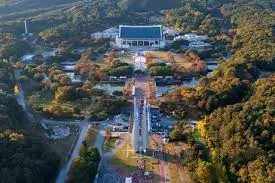
- Location
- 30 Gwangdeoksa-gil, Gwangdeok-myeon, Dongnam-gu, Cheonan-si, Chungnam, at the entrance to Gwangdeoksa
- Designation
- Designated a Natural Monument on December 23, 1998 (former designation No. 398)
- Age
- Estimated to be about 400 years old; not the first tree of the 1290 legend
- Size
- Height 18.2 m (20 m in some sources); splits into two trunks 60 cm above the ground
- Legend
- The story that Yu Cheong-sin brought saplings and nuts from Yuan China in 1290 (disputed)
- Walnut cakes
- Accounts conflict between the 1934 Jo Gui-geum and Sim Bok-sun story and a 1931 record of a Japanese-owned confectionery, so the original is unconfirmed
- Checked on
- 2026.10.11
A city you can reach on Line 1 without transferring, and a temple with a Goryeo walnut legend
The story of the Gwangdeoksa walnut tree
Cheonan is a city whose name appears on the Seoul subway map. Seoul Metropolitan Subway Line 1 was extended to Cheonan in January 2005, and trains still run from Seoul Station and Yongsan toward Cheonan and Sinchang. On these trains you can ride from Seoul Station to Cheonan Station without transferring, and according to a Cheonan university's transportation guide it takes about 1 hr 50 min. To save time, the KTX from Seoul Station reaches Cheonan-Asan Station in 35–50 minutes.[8][9][13][10]
How Cheonan became walnut country comes down as a legend. In September of year 16 of King Chungnyeol's reign in Goryeo (1290), Yu Cheong-sin, returning from Yuan China with the king, is said to have brought walnut saplings and nuts, planting the sapling inside Gwangdeoksa and the nuts in the garden of his hometown house. That's why the Gwangdeoksa area is regarded as the first place walnuts were planted in Korea, and a 'Sisikji' (first-planting site) stone marker announcing this stands in front of the tree. However, some local historians argue that Yu Cheong-sin never returned and that the story was made up to promote walnut cakes.[1][3][4][5]
The walnut tree now standing at the entrance to Gwangdeoksa was designated a Natural Monument on December 23, 1998 (former designation No. 398). Its age is estimated at about 400 years. A tree planted in 1290 would be over 700 years old, so the current tree is considered not the first tree of the legend but a later tree that grew afterward. It is over 18 m tall, and the trunk splits in two about 60 cm above the ground. The Gwangdeok-myeon area is said to still have around 250,000 to 260,000 walnut trees.[1][2][3][5]
Walnut cakes got their name in front of Cheonan Station. The most widely known story is that the couple Jo Gui-geum and Sim Bok-sun first made walnut cakes from Cheonan walnuts and red bean in 1934, which is the position of Hakhwa Walnut Cakes and Cheonan City. But the Busan Ilbo of April 12, 1931 ran an article saying that the owner of a Japanese-run confectionery in front of Cheonan Station won a rank-1 prize at a confectionery contest for 'kurumiyaki' (grilled walnut pastry). A local historian also revealed in early 2026 that the Joseon Shinmun of September 27 that same year had run a photo of a shop with a sign reading 'Cheonan specialty walnut cakes.' Who was first is still unsettled.[6][7][8]
To get to Gwangdeoksa, Cheonan city bus 600 goes all the way to the last stop. The route starts at Cheonan Bus Terminal, passes the East Square of Cheonan Station and ends at 'Gwangdeoksa,' with weekday buses every 70 minutes according to a bus info site. According to a 2009 article, it took about 50 minutes from downtown Cheonan to Gwangdeoksan Mountain. A good order is to see the walnut tree at the temple and buy walnut cakes in front of Cheonan Station on the way back.[4][11]
Good to know before you go
- Address
- 30 Gwangdeoksa-gil, Gwangdeok-myeon, Dongnam-gu, Cheonan-si, Chungnam
- Getting there
- From Seoul Station, take a Seoul Metropolitan Subway Line 1 train toward Cheonan or Sinchang and get off at Cheonan Station (about 1 hr 50 min without transferring). If you take the KTX, it's 35–50 minutes from Seoul Station to Cheonan-Asan Station; then take a Cheonan-bound train from Asan Station on Line 1, which connects to Cheonan-Asan Station, to Cheonan Station. From the Cheonan Station East Square stop, take city bus 600 and get off at the last stop, 'Gwangdeoksa.' Bus 600 starts at Cheonan Bus Terminal, so if you came by express bus you can board it right at the terminal.
- Good to know
- It was announced that Cheonan city buses will stop accepting cash from January 2026 (per a December 2025 news report). Load your transit card in advance. Bus 600 runs about every 70 minutes on weekdays, so you'd wait a long time if you miss it; check the arrival time in a map app first. On Line 1, some trains end at an intermediate station, so check that the destination sign says 'Cheonan' or 'Sinchang' before boarding.
FAQ
Can you get from Seoul to Cheonan on the subway alone?
Yes. Seoul Metropolitan Subway Line 1 extends to Cheonan, so if you take a train toward Cheonan or Sinchang from Seoul Station, you can ride to Cheonan Station without transferring. According to a Cheonan university's transportation guide, it takes about 1 hr 50 min.
Is the Gwangdeoksa walnut tree the very one planted in the Goryeo era?
No. The current tree is estimated to be about 400 years old. The story that Yu Cheong-sin brought walnuts in 1290 is a legend, and the current tree is considered a later tree that grew afterward.
When were Cheonan walnut cakes first made?
The most widely known account is that the couple Jo Gui-geum and Sim Bok-sun first made them in 1934. However, a 1931 newspaper records walnut cakes at a Japanese-owned confectionery in front of Cheonan Station, so the debate over who made the first ones is still going.
- [1] Encyclopedia of Korean Culture (Academy of Korean Studies) - Cheonan Gwangdeoksa walnut tree · Checked 2026.10.11 · Source
- [2] Korea Heritage Portal (Korea Heritage Service) - Cheonan Gwangdeoksa walnut tree · Checked 2026.10.11 · Source
- [3] Bravo My Life (E-Today) - Natural Monuments 'Yangnyeong-ri juniper' and 'Gwangdeoksa walnut tree' (2014-03-28) · Checked 2026.10.11 · Source
- [4] Seoul Shinmun - [Cities and Mountains] (11) Cheonan's Gwangdeoksan (2009-06-15) · Checked 2026.10.11 · Source
- [5] Seoul Shinmun - [Seo Dong-cheol's Cultural Heritage Tour with Stories] The walnuts a Goryeo minister brought from Yuan China, and the thousand-year-old temple that grew them into a Cheonan specialty (2017-06-24) · Checked 2026.10.11 · Source
- [6] Kukinews - [Cho Han-pil's Perspective] Who made the first Cheonan walnut cakes: kurumiyaki or Jo Gui-geum? (2024-03-25) · Checked 2026.10.11 · Source
- [7] Kukinews - Photo of a Cheonan 'walnut cake main shop' from 1931 found... Hakhwa's 1934 founder claim 'shaken' (2026-01-04) · Checked 2026.10.11 · Source
- [8] Seoul Shinmun - A Cheonan Samgeori trip by subway (2005-01-20) · Checked 2026.10.11 · Source
- [9] Sangmyung University Cheonan Campus - Directions (travel time from Seoul Station to Cheonan Station on Seoul Metropolitan Subway Line 1) · Checked 2026.10.11 · Source
- [10] Asamaru train timetable - Seoul Station → Cheonan-Asan Station KTX (updated 2026-10-11) · Checked 2026.10.11 · Source
- [11] BusTrain - Cheonan bus 600 route and timetable · Checked 2026.10.11 · Source
- [12] Kyunghyang Shinmun - 'Home care, cashless buses, culture pass for young people'... Chungnam's living policies change greatly next year (2025-12-31) · Checked 2026.10.11 · Source
- [13] Seoul Shinmun - Express trains on the Gyeongbu Line between Seoul Station and Cheonan expanded to improve convenience (2019-12-16) · Checked 2026.10.11 · Source
- [14] itwiki - Seoul Metropolitan Subway Line 1 (Asan Station–Cheonan-Asan Station connection) · Checked 2026.10.11 · Source
You might also like
Small-town trips outside Seoul: 7 roadblocks for foreign travelers
Head to a small city like Andong, Gongju or Gunsan and you'll run into walls that Seoul doesn't have: topping up transit cards, map apps, bus tickets, taxis, restaurant hours, museum closing days and accommodation verification. This guide sorts out seven roadblocks and the workarounds, checked as of October 2026.
Donghae Travel: Places to Visit, 1-Night 2-Day Itinerary and City Stories
A city with stories that go beyond the sea. True to its name, it's the first to greet the red sunrise, and it holds the wide blue sea in its arms. But Donghae's real charm is that it doesn't stop at the sea.
Gongju Travel: Places to Visit, 1-Night 2-Day Itinerary and City Stories
A city whose very name is full of story. Gongju locals still call one spot on the banks of the Geumgang River Gomanaru. It's the name of an old river ferry crossing lined with a thick pine grove, and also this city's old name.