
The Tomb of King Muryeong in Gongju: a 1,500-year-old royal tomb opened by drainage work
The Tomb of King Muryeong is the tomb of Baekje's King Muryeong and his queen, found by chance in 1971 while a drainage channel was being dug at the Songsan-ri tombs in Gongju. Thanks to the epitaph stones inside, it became the only royal tomb from the Three Kingdoms period whose occupant is known for certain.

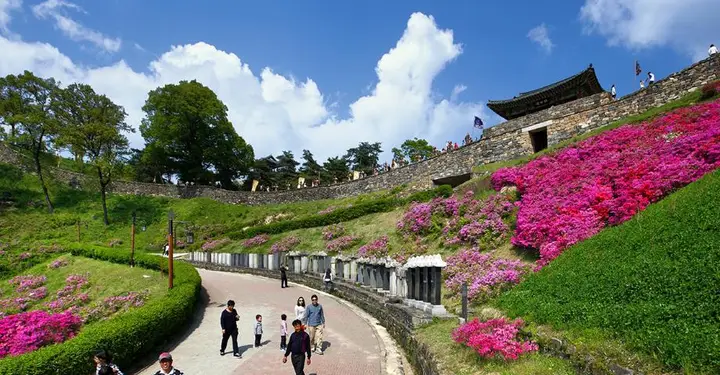
- Discovered
- July 5, 1971, during drainage work (to block moisture) at Songsan-ri Tombs No. 5 and 6
- Buried here
- King Muryeong, the 25th king of Baekje, and his queen (confirmed by the epitaph stones)
- Epitaph stones
- National Treasure; 2 land-purchase contract stones (maejigwon), held by the Gongju National Museum
- Artifacts
- 5,232 items (per the re-survey), including 12 National Treasure designations covering 17 items
- Name
- Formerly the Songsan-ri Tombs → 'Royal Tomb of King Muryeong and Royal Tombs in Gongju' since 2021
- World Heritage
- Inscribed in 2015 as part of the Baekje Historic Areas
- Checked on
- 2026.10.09
Digging a waterway, they found a royal tomb with its owner's name written inside
The story of the Tomb of King Muryeong
On July 5, 1971, while drainage work was underway to keep moisture from seeping into Songsan-ri Tombs No. 5 and No. 6 in Gongju, a brick tomb came to light. Gongju City says the tomb was excavated completely intact, just as it had been 1,500 years earlier.[1][2][4]
Two stone tablets found at the entrance revealed who was buried there. They were maejigwon, documents carved in stone at the funerals of the king and queen to buy the burial plot from the god of the earth, and the king's epitaph stone read 'Yeongdong Daejanggun, King Sama of Baekje.' According to the epitaph stones, King Muryeong died in May 523 and was buried in August 525, and the queen died in November 526 and was buried with him in February 529. The Korea Heritage Service describes these as the only maejigwon ever found in a royal tomb from the Three Kingdoms period.[3][4][6]
The excavation ended surprisingly fast. As word spread and reporters and onlookers crowded in, the team hurried to collect the artifacts, and the excavation was reportedly finished in just 12 hours. Professor Kim Won-yong, who led the team, is said to have later regretted it many times, calling it his biggest mistake.[6]
The artifacts were first counted at some 4,600 items, but a re-survey by the Gongju National Museum confirmed 5,232. Of these, 17 items under 12 designations are National Treasures, and the epitaph stones, also designated a National Treasure, are at the Gongju National Museum. The tomb group became a UNESCO World Heritage Site in 2015 as part of the Baekje Historic Areas, and in 2021 its old name, 'Songsan-ri Tombs,' was replaced with 'Royal Tomb of King Muryeong and Royal Tombs in Gongju.'[3][4][5][8]
King Muryeong's ties to Japan have been passed down, too. The Nihon Shoki records that he was born in 461 on an island called Kakarashima, off northern Kyushu, while his father Gonji was on his way to Wa (Japan). Every year since 2002, a King Muryeong birth festival has been held on the island on the first Saturday of June, and people from Gongju take part too. You can read his birthplace as a story handed down through records and tradition.[7]
Good to know before you go
- Address
- 37 Wangneung-ro, Gongju-si, Chungcheongnam-do
- Hours
- March–October: 09:00–18:00; November–February: 09:00–17:00 (entry until 30 minutes before closing)
- Closed
- Major traditional holidays and New Year's Day
- Admission
- Adults 3,000 KRW, teens and military 2,000 KRW, children 1,000 KRW (group discounts for 20 or more)
- Getting there
- From Gongju Bus Terminal, take city bus no. 101 or 125, get off at Gongju Arts Center, and cross the street.
- Good to know
- Parking is free. Actual artifacts like the epitaph stones are at the Gongju National Museum (34 Gwangwangdanji-gil, Gongju-si), so visiting both keeps the story going. Inquiries: 041-856-3151.
More to see in Gongju
In the Gongju travel guide, you can keep reading about courses, restaurants and closing days. Gongju is one of the cities Randomtrip picks for you.
FAQ
Where can I see the epitaph stones and gold crown ornaments?
Artifacts excavated from the Tomb of King Muryeong are held by the Gongju National Museum. According to Korea Heritage Service records, the epitaph stones are also located at the Gongju National Museum.
What are the hours and fees?
From March to October it's open 09:00–18:00, and from November to February 09:00–17:00; you can enter until 30 minutes before closing. Adults pay 3,000 KRW, and it's closed on the days of major traditional holidays and on New Year's Day (per Gongju City).
Is it true that King Muryeong was born in Japan?
The Nihon Shoki records that King Muryeong was born on Kakarashima, an island off northern Kyushu. It's a story passed down through records and tradition, and today people from both Korea and Japan hold a birth festival together on that island.
- [1] Gongju City Culture & Tourism - Royal Tomb of King Muryeong and Royal Tombs in Gongju · Checked 2026.10.09 · Source
- [2] Korea Heritage Service Heritage Info - Royal Tomb of King Muryeong and Royal Tombs in Gongju (Historic Site) · Checked 2026.10.09 · Source
- [3] Korea Heritage Service Heritage Info - Epitaph Stones from the Tomb of King Muryeong (National Treasure) · Checked 2026.10.09 · Source
- [4] Encyclopedia of Gongju Culture (Academy of Korean Studies) - Tomb of King Muryeong · Checked 2026.10.09 · Source
- [5] Segye Ilbo - See the artifacts from the Tomb of King Muryeong in Gongju at a glance (2021-09-13) · Checked 2026.10.09 · Source
- [6] Seoul Economic Daily - Everything about the Tomb of King Muryeong, found after 1,500 years and excavated in 12 hours (2021-09-13) · Checked 2026.10.09 · Source
- [7] Encyclopedia of Gongju Culture (Academy of Korean Studies) - King Muryeong Birth Festival · Checked 2026.10.09 · Source
- [8] Gongju National Museum Ungjin Baekje Culture Archive - Records of the Tomb of King Muryeong special exhibition · Checked 2026.10.09 · Source
You might also like
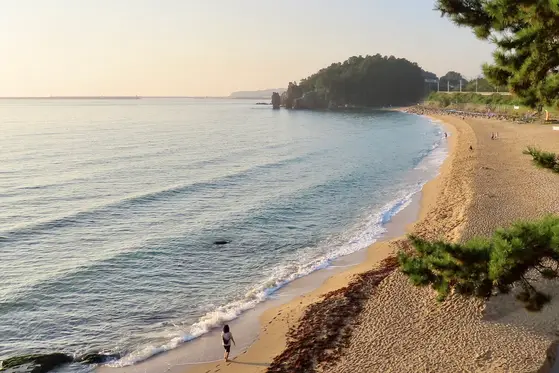
Donghae Travel: Places to Visit, 1-Night 2-Day Itinerary and City Stories
A city with stories that go beyond the sea. True to its name, it's the first to greet the red sunrise, and it holds the wide blue sea in its arms. But Donghae's real charm is that it doesn't stop at the sea.
Gongju Travel: Places to Visit, 1-Night 2-Day Itinerary and City Stories
A city whose very name is full of story. Gongju locals still call one spot on the banks of the Geumgang River Gomanaru. It's the name of an old river ferry crossing lined with a thick pine grove, and also this city's old name.
Yangyang Travel: Places to Visit, 1-Night 2-Day Itinerary and City Stories
Yangyang, the land where the sun rises. The name Yangyang was given in 1416. It was borrowed as-is from Yangyang (Xiangyang) on the banks of China's Hanshui River, because this area's terrain and natural beauty resembled it.